Friday, July 22, 2011

Hunger pains

It's mid afternoon on March 11, 2011 and we - my husband (Dale) and myself, seven International Studies students from St. Stephen's University (http://www.ssu.ca/), our host - Tim Bannister (a Canadian Baptist Ministries global field staff serving with his wife, Diane, in Kenya) and our driver, Mike, are on our way back to "the ranch" - Tim and Diane's place on a game refuge, about 40 minutes outside Nairobi. We're a little tired, but excited, inspired, hopeful, cautious, conflicted. We've just spent several hours with a group of Kenyans at a small African Brotherhood Church (ABC) in the village of Thange.

The African Brotherhood Church is an indigenous African denomination with whom Canadian Baptist Ministries (CBM) has a covenant partnership agreement in Kenya. That means that we - CBM - and they - the ABC - have covenanted to work together in integral mission. Integral mission is an approach to mission wherein that recognizes that humans are integrated beings - heart, mind, soul, spirit, body. To be the body of Christ in the world requires that we respect this integration of the human being.Therefore, it's not possible to be concerned only with the spiritual state of a person, without consideration of their emotional, social, physical and intellectual health.

So, in Kenya, CBM and the ABC work together to serve the needs of individuals and communities. We're partners, providing micro loans, helping farmers develop sustainable agricultural methods, building water catchment systems with local churches, proclaiming and demonstrating the love and grace of Christ in a parched land. We've crossed cultures and all kinds of other man made borders and boundaries - we're partners. To be sure, our partnership has had its ups and downs as we've tried to figure out how to do mission and ministry together. It's not easy but it sure is rewarding on a day like March 11, 2011.

Our visit with the church in Thange has included a number of demonstrations. This vibrant and determined congregation has initiated a variety of projects to benefit their own members and the surrounding community.

1. We've eaten meat that was cooked during our visit in a solar cooker - a small, fairly low tech contraption which uses the sun's energy to cook food slowly but efficiently, without further destruction of the local environment.

2. We've seen a water catchment system that collects rain water from one side of the church roof in a huge cement tank and then makes it available to local residents. In a country which suffers from chronic drought, every drop of water is valued and every innovation which allows water to be captured and used wisely is celebrated.

3. We've seen - and tasted! - water that has been filtered on site, using a Kenyan made water filtration system that is reliable, sustainable, and available. As I'm sure you know, clean water is more valuable than gold for those who need it to protect themselves and their children from the many water borne diseases that wreak havoc in countries like Kenya.

4. We've seen a seedlings project by which this small group of Christians have produced seedlings of various varieties for themselves as well as seedlings to sell to their neighbours as an income generating project. They're using some of the seedlings for reforestation to improve the climate and prevent soil erosion. Some of the seedlings are fruit trees which provide - obviously - fruit.

5. We've been introduced to a few of the goats that they have distributed to local families and we've heard about the many ways that these goats can improve the daily lives of their host families - milk, cash income from selling excess milk, and eventually, as the goat reproduces, the option to sell a goat in order to secure money for a child's education. It's amazing how a goat can change the lives of an entire Kenyan family!

6. And speaking of family, the last "project" that we see is the church's work with AIDS orphans in the community. This small church is caring for 15 orphans - 15 children ranging in age from about 5-15, who are amongst the most vulnerable of the vulnerable.

It's been a full day. And then we sit down together in a shady spot and share a meal together. Meat cooked in the solar cooker. Rice. Vegetables grown locally. Unpasteurized honey, produced locally. Doughy things that are delicious and reminiscent of something we call "fried dough" at home. Filtered water. A genuine 100 mile diet, though in truth, probably a one or two mile diet! And noisy, happy conversation. We're family, sharing - albeit briefly and a bit awkwardly - the bounty of the kingdom.

And then there are the parting formalities. They thank us for coming and for CBM's support. We thank them for their hospitality and their witness to their community through these integral mission projects. And then an old woman - I dare not guess her age - but certainly a great grandmother - presents us with gourds that she has dried and decorated - carefully, lovingly, gratefully. Through a translator, she tells us how much she has appreciated CBM and how much the support that we (as representatives of CBM visiting Thange) has meant to her. The gourds are a gift, a tangible expression of her appreciation. We're moved to tears as we accept them and feel the bonds of fellowship and partnership strengthen.

Amidst hugs and dancing and singing, we gradually make our way to our vehicles and take our leave - one more group of strangers and partners who have made the trek to this fairly remote Kenyan village to be impressed and inspired by the industriousness and vision of a collection of brothers and sisters whose day to day lives are so very different from our own. And yet, they are working together with what (little) they have, to hold back despair and hopelessness and even hunger and thirst.

During the long ride back (3 or 4 hours on a pretty treacherous highway!) to Tim's, Dale is talking with Mike (our van driver) about what we have seen and is surprised to hear Mike describe these folk as "middle class", rather than "poor". And yet, middle class or not, he states bluntly that if the rains don't come to Thange soon, these people will be eating roots and experiencing symptoms of malnutrition before fall. It's a stark reminder of the inherent insecurity of any food production system that relies on nature's fickle rhythms. It's a system that once worked well and perhaps still can, if only there is rain.

We quietly reflect on the lesson we have seen lived out amongst our new friends. Our partners. In Thange, life can be lived and enjoyed - or endured - but one day at a time, for we know not what tomorrow may bring.

We've been back in Canada for over four months now but I still think about the church in Thange. I wonder how they're making out. Tim tells me - and the CBC News tells me - that parts of Kenya (and neighbouring countries) are indeed suffering severe drought conditions. The rains haven't come in many, many areas and the situation is dire. The UN has called it the worst drought and famine in decades (see http://www.youtube.com/watch?v=5fDKAnES1S8 for an up to date youtube report from the UN).

As I type this blog, I'm conscious of the fact that we're worlds apart. We hear and read about the famine and drought as we're enjoying our daily high calorie feasts and watering our lawns and flowers and consuming vast quantities of water, rarely thinking of water as a precious commodity. It's sad to think about the situation in eastern Africa, especially when we've so recently been there and can still picture the people we met who generously shared their table with us only a few months ago. But what can we do? The problems are so much bigger than we are and solutions are so far beyond our resources.

Here's a few suggestions:

1. Follow the news about east Africa - on tv, radio, internet. Don't allow yourself to retreat from the pain and suffering. These are real people. They have families. They love and are loved. They have hopes and dreams. So, for their sake, be informed.

2. Use this as an opportunity to take stock of your own habits of consumption. Be honest with yourself. How wasteful are you? How much do you take your daily bread (and water) for granted? How generous are you with those things which are yours to consume (or share)?

Raise awareness amongst family, friends, and colleagues about these things. Be gentle but don't settle for comments like "Isn't it awful." Of course it's awful, but what can be done? Maybe when we start looking for answers, we'll find them... or at least we'll learn something useful from the search.

4. If you're able to (and who among us isn't?), give of your finances, your prayers and your time to organizations that are already working on the ground in east Africa. Support organizations that have already invested in relationships and partnerships. Go to http://www.cbmin.org/cbm/news-archive?news_id=158 and http://www.foodgrainsbank.ca/east_africa_drought.aspx if you want to get involved in this way.

Our partners in Kenya are courageous. They are resourceful and resilient. And they know a God who does not disappoint them. They are not pitiful, but proud.

Malnutrition and starvation are evils that ought not to exist in this world. Hunger is a pity but I wonder who is more to be pitied: those whose mortal body is wracked by the ravages of physical hunger or those whose immortal spirit is wracked by the ravages of selfishness and insensitivity and idle complicity in systems of injustice?

We can no more singlehandedly solve the complexities of global hunger than we could become performers in the Cirque du Soleil, simply by wishing for the strength and agility and talent of those amazing performers. But we can do something about global hunger, even if it's as little as reducing our own waste and contributing to the efforts of those who are more strategically placed to help distribute food to the hungry and implement sustainable practices of food production around the world. There is absolutely NO EXCUSE for complacency, indifference or inactivity.

I've just heard that the Canadian government has committed to match - dollar for dollar - all donations made to organizations (including CBM and Canadian Foodgrains Bank) for relief efforts in east Africa. See http://www.theglobeandmail.com/news/politics/canada-surprises-aid-groups-by-donating-extra-50-million-for-famine-hit-east-africa/article2106550/. Dig deep and give generously, not just for this crisis, but for the long haul. The money will help ease the physical hunger pains for some, but more than that, it will help spread the peaceable kingdom - on earth as it is in heaven!

IMPORTANT UPDATE: Donations made to CBM between July 6 to September 16 for East Africa drought relief will be eligible for matching through the Canadian International Development Agency (CIDA). An application will be made to CIDA for matching funds concluding the window for donations allotted by the government.

For more info: http://www.acdi-cida.gc.ca/acdi-cida/ACDI-CIDA.nsf/eng/ANN-72082543-GL5

And here’s the link to CBM's info and donation page: http://www.cbmin.org/cbm/KenyaDroughtRelief

Wednesday, July 06, 2011

The Risk of Hospitality

I’m not a risk taker. I don’t buy lottery tickets. I don’t run for political office. I don’t engage in extraordinary life threatening activities. I don’t carry a gun. I don’t negotiate with terrorists. I don’t cheat on my income tax or lie to customs officers. I don’t speed - well, hardly ever. Like I said, I’m not a risk taker. I follow the rules. The most dangerous thing I do is teach. But that’s a subject for another day.

I don’t take risks because I don’t have to. I follow the rules because the rules are made by people like me to protect people like me.

My mother once said that I led a “charmed life” - by which she meant, I think, that things always seemed to work out. She was right. I am educated, financially stable (as much as anyone can be these days), successful, white. Sure, I have setbacks, but they tend to be minor and manageable. They serve to remind me that I'm not God and, more and more these days, that I'm getting older.

It’s not all Hollywood and happy endings, but the reality of my life is unbelievably easier than the reality of the lives of billions of people on this planet. And it's not because I'm somehow better than other people - more virtuous or closer to God. The fact is, I don’t need to offer a bribe in order to secure medical help for myself or a loved one. I don’t need to choose between acting within the confines of a Judeo-Christian morality OR having enough food to eat. I don’t need to lie, cheat, steal, or kill in order to make it through the day. And if I should choose to lie, cheat, steal or kill, it’s not about survival but about justifying a self centeredness that wants to get ahead – to be seen as being “better”, wealthier, more powerful, stronger. A step above those around me.

No, I’ve never had to chip away a fragment of my integrity for a piece of bread, or surrender my good conscience for a night’s sleep. But that doesn’t mean that I wouldn’t or that somehow I’m immune from the sordid, risky actions of the desperate. I haven’t sold my soul for a bowl of soup, because I’ve never been THAT hungry.

I’m comfortable and content. And I – or at least people like me – continue to make and enforce the rules – rules that make sure that the game doesn’t change.

Sure, I can see injustices, and I can speak against them, but at the end of the day I'm still well fed, comfortable and secure. And to be honest, I'm thankful for that. I don't want to be tested. I really don't want God to ask me to give all that up. I might try to convince myself - and you - that IF it should come down to it, I'd be willing to give up anything and everything if it's God who's asking. If I know for sure that it's God and I know for sure that he's asking me to give everything up. When I read the story of the Rich Young Ruler, I tell myself that I wouldn't have gone away sad from that encounter. That I would have done just what Jesus asked - sold everything I have, given the money to the poor and joined Jesus' ragtag band. But the truth is, I'm hiding in the crowd, head down, hoping that Jesus doesn't put me on the spot. I'm certainly not going to do anything so foolish as to march right up to him and ask him what he wants me to do! I'm not going to rock the boat or draw attention to myself. I'm too busy leading my charmed life and justifying myself.

As I write this, I realize that it probably sounds a bit like self-flagellation. Why beat myself up like this? It's not my fault that I'm privileged. And for sure I can think of lots of people who have more to give up - or hold onto - than I do. But that's not really the point.

Where I'm going with this has more to do with my attitude toward those whose reality is far different than mine - those who have to take risks, and make choices, and do things that are shameful. If God calls us into the community of believers - to be brothers and sisters with men and women from all walks and classes of life - the challenge is to adjust my attitude so that I can form good, healthy relationships across all kinds of barriers. I think what is missing in my life - and may I be so bold as to suggest that it may be missing in the lives of many of us? - is a real understanding of the biblical principle of hospitality.

When we are willing to take the risk of hospitality, we extend favour to another - not because they deserve it but because they need it and simply because we have the capacity to meet that need, whatever it may be. And when we do it out of our love for Christ and obedience to his command that we ought to love our neighbours as we love ourselves - no questions asked - maybe that's what evangelism looks like. Hospitality isn't just getting together with friends and family over a meal. It's denying ourselves - even to the point of laying down our lives - so that we can bring the blessing of community to those in our path. I can't help thinking that our faith would have a whole lot more credibility if we become a community that learns to take the risk of hospitality - no strings attached.

I've just watched the movie, Les Miserables. There's a scene at the very beginning when Jean Valjean, a newly released convict, comes into town and is settling in for the night on a park bench. An old woman tells him to ask for hospitality at a nearby home - the home of a Bishop Myriel. Valjean is amazed that the Bishop will welcome him to his table and provide a bed for the night and he reiterates that he is a convict. He says to the Bishop, "how do you know that I'm not a murderer?". Bishop Myriel replies that "we will have to trust one another." As it turns out, Valjean steals the silverware and disappears in the middle of the night, only to be arrested and brought back to have his identity confirmed by Bishop Myriel. Much to Valjean's amazement, however, the Bishop corroborates his story that the silverware was a gift. And thus Valjean is released from custody and Bishop Myriel tells Valjean that he has purchased his soul. He must change his ways. And he does. It's a wonderful and inspirational story of redemption, rooted in the hospitality of Bishop Myriel. What if we all extended that kind of grace - and redemptive redirection - to the scoundrels in our lives?

Tuesday, June 21, 2011

The Young and the Restless

The initial assumption that the post Stanley Cup "Vancouver Riot" was primarily the work of anarchists, has now given way to the realization that most of the vandalism and looting was actually done by youth. I've been thinking about that and I suspect that there are a number of factors at play. Of course much has been made of the pictures and video clips that are circulating online and that have been submitted to the authorities as evidence. There are valid questions about the vigilanteism that these events have triggered, the naming and shaming campaigns. And debates are raging about the appropriateness of sanctions for those who participated in the vandalism. Take the 17 year old - Nathan Kotylak - whose dreams of representing Canada as an Olympian (in water polo) now seem to be in jeopardy because of his actions that night. Or people who have lost their jobs. Or people who have received threats to their person or property. To what extent should those who participated in acts of vandalism and looting be held accountable, and how? Where should the vigilanteism stop, and how?

Here's at least a partial list of some of the factors that I think may have contributed to the chaos that night:

1. mob behavior - a mob does not have a conscience and so people will do things in a mob that they wouldn't do on their own;

2. the consumption of alcohol surely played some role in the events. Alcohol impairs judgment. A little alcohol impairs judgment a little and a lot of alcohol impairs judgment a lot. And that's even if there's no crowd effect;

3. although it does seem that youth were the ones doing most of the damage, I suspect that there were those in the crowd that night whose purpose was solely to stir up the crowd and incite them to violence and hooliganism;

4. the emotional state of many youth in our country (and in fact, around the world) these days is a tinder box - in Canada, figures out today indicate that the rate of youth unemployment is 13.9% (as compared with the National average of 7.4%). Combine this with two other facts: youth debt loads and the expectation that a post secondary education is a step to a better - i.e. more financially secure - future. Our youth are frustrated and perhaps it's not that surprising that that frustration should erupt into violence when an opportunity presents itself. Believe me, I'm not looking for excuses for bad behavior - just saying...

5. General sense of instability and anomie - a term used by French sociologist, Emile Durkheim that is roughly translated as "a state of normlessness". That is, the realization that the game has changed and we don't know how to deal with it. Besides the things listed in #4 above, post modernism (with its deconstruction of societal norms and values), the high rate of family breakdown (and I know that this isn't a popular sentiment, but I suspect that we have only just begun to see the impact of divorce on our children and grandchildren and great-grandchildren), and the general sense of doom that is conveyed by the media on topics such as the global economy, climate change and environmental impacts, terrorism, etc. all contribute to a deep rooted sense of cynicism. Many youth - from all socio-economic backgrounds - find it hard to be hopeful in the face of all of the global and personal uncertainties;

6. Facebook and the larger world of social networking deserves a mention as well. Facebook gives youth the sense that they can create and maintain a fictitious reality, and at times, the fiction is more powerful - more real - than the actual reality. I wonder, though I'm not a psychologist, if this tendency to live vicariously through the fiction of facebook is perhaps producing a sort of dissociative disorder which affects individuals, but also our society. Capturing images digitally has taken on an immense role in our everyday lives. It's almost as though the image (perhaps doctored through photoshop or other programs) is more important than the experience it is meant to portray. Hm.

7. A culture of impunity where we have systematically protected our children from bearing responsibility for their actions. We have, it seems to me, thrown them into a moral abyss, where they only have to be accountable if they're caught, and not even then if we can figure a way around it. Young people engage in all manner of reckless behavior that endangers themselves and others, but yet we shy away from holding them responsible. We expect youth to have sex, to experiment with drugs, to drink regularly and to excess, to cheat, to lie. In fact, parents who aren't okay with all this are considered old fashioned and repressive - even bad or abusive parents! Have we lost our minds?!

8. A sense of entitlement. Let's face it - we have happily (for the most part) gone along with the business mandate that puts consumption ahead of everything else. Nothing is as powerful - not integrity or character or relationships or self respect - NOTHING is as powerful as our value as consumers. And our kids - that is, the children of the baby boom generation - have grown up expecting to have MORE and MORE and MORE again than their parents. They're entitled. And if they're from the middle class or the upper class, then the culture of entitlement is almost boundless.

Again, I'm not looking to make excuses. But it seems to me that this is a pivotal moment where we can either learn from this event - in all of its ugly dimensions - or we can sweep up the mess and settle for just putting it behind us - and quickly, before it has a negative impact on the tourism industry in Vancouver. This is a wake-up call. Let's not push the snooze button!

Tuesday, May 24, 2011

For every action...

There are lots of things that I’ve forgotten from my high school science classes but one thing that has stuck with me is the proposition that for every action there is an equal and opposite reaction - Newton's third law of motion.

There are lots of everyday examples: you hit a ball with a bat and the distance the ball travels depends on how hard it was hit, the angle, the wind conditions; you ride a skateboard and use your foot to propel the skateboard forward; an airplane pushes back on the air and the air pushes forward on the plane. One thing leads to another in predictable and inevitable ways.

Since 1687 when Newton published the three laws in his work PhilosophiƦ Naturalis Principia Mathematica, these laws have helped us to understand and predict the effects of objects acting on one another.

There is a sort of comfort in the predictability of objects. And as much as I might like surprises and the adrenalin rush that comes from successfully navigating random circumstances - the curve balls of life - I realize that everyday life would be totally overwhelming were it not for a degree of predictability. But having said that, I am so incredibly thankful for the unpredictable and even the chaotic. The things that come at us out of the blue. I suppose that we have an innate tendency to want to maintain balance - or, if thrown off balance, to regain it.

Life wouldn't be much fun if everything was predictable, routine, according to plan. I sometimes worry that heaven - a place where there is no sin or sorrow or suffering - might actually be a little boring. It's hard to imagine a place or time when people will always act with integrity - always do the right thing for the right reasons and in the right way - and the outcomes will always be such that they don't produce pain or suffering, for anyone. I don't actually spend much time thinking about that though, because life at this moment is a long way from that. A very long way.

Life in the present moment is riddled with unpredictability. People act and react out of all kinds of motives - some selfish and others quite philanthropic. Our actions have impacts that we can't possibly even trace, let alone predict.

When the French philosopher, August Comte (1798-1857) first used the term sociology, he had in mind that this new science would identify the natural laws governing social behaviour. The search for these laws, however, has proved futile. When it comes to the social world, Newton's third law of motion - for every action there is an equal and opposite reaction - is clearly NOT applicable. The reaction may be neither opposite nor equal to the initial action. In the social world, all bets are off. What may seem like a negative outcome, may, in the long run actually prove to be have a positive impact, and vice versa.

The ancient Greek philosopher, Heraclitus, said that "you could not step twice nto the same river." In other words, even though you may go down to a river at the same time every day and step into exactly the same spot, neither the river with it's flowing water, nor you with your ideas and attitudes, can be exactly the same. The social world is always changing!

Another French sociologist, Emile Durkheim (1858-1917) argued that society is equal to more than the sum of its parts. Sociology became the social science that is concerned with that nebulous field of the "more" - the ever changing, shifting, sometimes incredibly beautiful and sometimes immensely ugly "more". The interstitial spaces between philosophy, history, economics, psychology, anthropology, political science, etc.

For those who like predictability and certainty - those who like things to be well ordered and neat and tidy - sociology must surely be incredibly frustrating. But for those who thrive on the edges of uncertainty - who love seeing the complex web of uncontrollable, rogue variables - the sociological study of society is immensely gratifying.

I am a sociologist. I'm also a person of profound faith in a triune God who, it seems to me, is also equal to more than the sum of the parts. Father, Son and Holy Spirit are not simply three unique beings who share one mind and one throne. And the reality that they preside over is not two dimensional and systematic. As the river is ever changing, so too is our reality as we make our way through the maze of physical, social and spiritual life on a capricious planet. God's grace is new every day because our need for grace is in constant motion.

Many Christians have an uneasy suspicion of sociology. I suspect that they may be the very Christians who prefer to define and defend a God who they have reduced to the level of complexity that they are comfortable with, which frankly, isn't much. They're people who don't like the messiness of a world where it's hard to tell with any degree of certainty what will happen as a result of their actions, or the actions of others. They're likely to be people who will opt for programs with proven results, rather than to boldly (even recklessly) act on the principles of conduct described so eloquently in the Beatitudes and the Sermon on the Mount (Matthew 5-7).

This new way of life was taught and modelled by a Messiah who, when the chips were down, overcame the very real temptation to opt for safety and security and as a result, found himself on a cross with only his vision of another world - a more just world - to sustain and comfort him. Greater than the physical agony of a brutal death was the spiritual anguish of being wrenched from the trinity and left on his own - a solitary figure, beaten and ridiculed - but ultimately not destroyed.

If Newton's third law of motion were applicable to the actions of men then we might expect that the crucifixion of Christ would be countered in his resurrection - an equal and opposite reaction. And I suppose that there are those who see it this way. But I believe that the resurrection of Christ has a magnitude of impact that is far greater than we can even imagine, let alone understand. It was a game changer in that it opened the door to a whole new dimension - a reality where the separation between God and man is bridged and we, mere mortals, are invited to live by the principles of a different Kingdom and in the presence of the King, eternal, immortal, invisible (1 Tim. 1:17).

When Christ ascended, he took his place (once again) in the trinity, but more than that, he declared that we are eternally united with him as joint heirs of the Kingdom (Romans 8:17). No wonder Paul urged the Ephesians (and us!) to live a life worthy our our calling!

Monday, May 16, 2011

The elusive happy medium...

I've always thought that if I were ever to write a book, I would call it The Elusive Happy Medium. Pretty self explanatory. And in my experience, almost a truism that finding that medium (which is purportedly "happy") is inevitably a wild goose chase. I'm not, first of all, convinced that the medium - the middle ground - is particularly "happy". I tend quite naturally to be a pretty middle of the road kind of person - always weighing the arguments and evidence on both sides of an issue - and I have to say that that can be immensely satisfying, but it can also be immensely frustrating.

It might be more fitting to call it the "sober medium" or the "subdued medium". It's certainly not a place of innate passion. It's not a place for risk takers, pioneers or those that like to push the envelope. No, the middle is safe, predictable, cautious, biased toward the status quo. It's warm, tepid, neither hot nor cold. I suppose these things might make some people HAPPY, but as much as I appreciate the importance of those who inhabit this place, I aspire to be the kind of person who thrives on more colour; more excitement; more danger. So I find myself in a paradox (certainly not the first time!). I simultaneously long for stability and instability. Passion and predictability. Excitement and routine. I long for more of the same at the same time that I long for change.

Maybe this is the fulcrum of the pendulum. The pendulum swings back and forth, always pivoting around the middle but never resting there. I wonder if this is even a principle of life as we know it in the physical realm as well as in culture.

As I look out my front window at the Bay of Fundy, I'm very conscious of the extremes of nature. We've had rain for days. The tv news channels are covering the floods along the routes of the Assiniboine and Mississippi Rivers. And yet I just returned from Kenya a month and a half ago and am haunted by the effects of persistent drought in areas of sub saharan Africa. When it comes to rain, the medium between drought and flood would be a happy place, I think! And if we look at cultures and the history of their development, we can usually track a pretty erratic route as excesses in one direction are corrected by excesses in the opposite direction.

On the other hand, there are religious extremists. Surely that's not a model to emulate, but yet neither is it desirable to practice our faith dispassionately, soberly.

What if this whole tendency to think in terms of dichotomies is the problem? What if the reality is that we don't have to choose between extremes but rather that life is more of a kaleidoscope - ever shifting, perpetual, colourful motion - that bids us let go of the impulse to control events, circumstances and possibilities. That bids us to simply enter into the mysteries of life. For me it's not a natural thing. I like to know what to expect.

I like to have confidence that there is a plan and that things "make sense". It's hard for me to let go of those things. Faith in a god who so often seems capricious, is not natural. It requires us to look past the reality that is before us and to trust in a reality that is beyond us. It's not predictable and it's not safe - or maybe it is safe - if, in fact, God is good and to be trusted. But that only is a possibility if this world - with its floods and droughts - it's extremes of all kinds - is not the final story. If what we see is NOT what we get.

The elusive happy medium? I don't know. For now it's all I can do to hold on tight to the pendulum as it swings back and forth!

Friday, May 06, 2011

The girls... and boys... feminism has left behind

I've often shied away from identifying myself with the "feminist" movement. And yet I'm grateful for many of the changes feminism has brought about in our society. I have no doubt that my life is very different than life was for my grandmothers and great grandmothers. And I'm thankful for that. For many women today, life IS better. We vote, get educated, have careers, juggle family and work, run for political office, enter the ministry, get married - or not, play sports, own property... It may still be a "man's world", but women can hold their own. At least some women.

Having traveled in several developing countries I'm quite conscious of the fact that the majority of women around the globe do not enjoy many of these privileges. Despite the fact that women often draw on deep reservoirs of strength when faced with horrendous situations, enduring unspeakable hardship and abuse, the everyday reality for these women is oppressive on many levels. And yet, development specialists readily acknowledge that women MUST be involved in development initiatives if they are to succeed. The United Nations, in defining the 8 Millennium Development Goals, recognize the critical importance of promoting gender equality and empowering women (goal #3) if the goal of eradicating extreme poverty is to be realized. Stephen Lewis, former UN special envoy for HIV/AIDS in Africa, has often noted - in his passionate and articulate style - the role that grandmothers play in holding Africa together. I've seen with my own eyes the incredible strength of Kenyan women, as they mobilize their communities to engage in community development projects and care for AIDS orphans. I applaud efforts to empower women, but I'm also just a bit uneasy.

I worry about the messages that we are giving to girls - YOU can make a difference! YOU can solve the problems in your society! YOU are the heart of your community! YOU can pull your family out of poverty! These are the messages of the Because I am a Girl campaign (see http://plancanada.ca/becauseiamagirl?WT.mc_id=BIAAGFY11GS18). It's not that I don't believe these things. I DO believe that girls can make a difference. I know that they have enormous potential for good when they're given half a chance. I fully support efforts to ensure that girls have the opportunity to attend school. My concern is this: what do these messages - intended to encourage and inspire GIRLS - say to BOYS? Do they imply that boys can't make a difference? Can't solve problems in their society? Can't be the heart of their community or pull their family out of poverty? Because they are boys, they CAN'T be counted on?

Can we foster gender equality and empower girls and women without DISEMPOWERING boys and men? And another thing: if we look at the ways that the feminist movement has impacted our own society, we have to be brutally open about looking at both the successes AND the failures. There may be some debate about how to define success and failure, but for me the successes are the things I listed above - voting, education, jobs, etc. On the other side of the ledger though, are lots of other things that indicate that girls are still trapped in unhealthy ways of seeing themselves and their role in society. Things like: the rates of eating disorders amongst girls and young women; stories about middle school girls performing oral sex for money at lunch time; accounts of girls - individually and in groups - bullying other girls, either online or in person; the rates of abortion in our society and the way that abortion is defined as a "women's right"; and so on. I can hardly turn on the television and flip through the channels at any time of the day or night without being confronted with reality tv shows that depict women as manipulative, conniving, vengeful, stunningly beautiful but somewhat dull-witted chameleons.

Are THESE women the heart of their community? Are THEY pulling their families out of poverty, making a difference, solving their society's problems? The way I see it, they are products of a feminist movement in our country. I'm not BLAMING feminism. I know that this is NOT what the early feminists had in mind when they sought to empower women. But we need to face the fact that these issues have somehow evolved out of the primordial soup of feminism.

Have these women been left behind by feminism? And what about boys and young men around the world - from the most developed to the least developed countries? Everywhere I look I see young men - boys 14 or 15 years old to men of 25, even 30 - who are restless, angry, dangerous. Males who do not know who they are. Males who have somehow failed to live up to some unwritten standard or code. Males who may seek meaning and an identity by banding together with other lost males, in gangs and militias and (maybe even) armies. Is it possible that these too, have been left behind by feminism?

On a recent trip to Kenya our team encountered a young man of 25. He had graduated from high school - a feat in itself in Kenya - and yet here he was on a Saturday morning, unemployed, drunk and wandering the streets. He had been trying to get into the military for several years but didn't have connections or money to bribe his way in. As hope leaked out of his life, he was giving into the temptation to let alcohol numb his pain.

Later in the same trip we had a meeting with some Christian youth leaders when we attended a networking session around HIV/AIDS awareness. The youth took turns reporting on their activities and discussing the merits of working together. These were all very bright young people, but amongst the young men, there ran a strong current of resentment and anger.

How many angry and resentful young men are there? What kinds of situations or events might cause that anger to flare up?

I can't help thinking that with all of the international attention going to the cause of gender equality and empowering women, these young men may be left behind... and that could prove to be very dangerous for all of us! Development experts recognize the need for engaging women in development efforts, but I would love to see development agencies also find ways to give these young men a purpose and an identity that will channel their ambitions and energies in a positive direction. The challenges facing our world are great and we will need all of the resources and energies and talents at our disposal - from both women AND men - if we are to grapple with them effectively. Yes, we should work for gender equality and empowering women, but not by dismissing or grinding down or disempowering men. Both men and women need to see power, not as a weapon to wield for personal gain, but as a trust to be used in order to create a future where no one is left behind.

Saturday, April 02, 2011

Enough!

People are complicated... and sometimes incredibly frustrating. And ideas are never inert, powerless mental constructs - they always have energy and capacity and incredible power. Sometimes that power is measured and predictable, but often it is erratic, even crazy. If humanity has learned anything over these past 5000 or so years of recorded history, we should know that we need to respect the power of ideas, even ideas that are offensive to us - maybe ESPECIALLY ideas that are offensive to us. Ideas can be deadly.

I'm thinking about the news these last few days of riots in northern Afghanistan that have resulted in the deaths - gruesome deaths by the sounds of it - of a number (perhaps as many as 20!) of United Nations staff, allegedly in protest over the burning of a Quran in the United States. Some could certainly argue that the actions of this one person led to quite predictable results. In fact, this same person was dissuaded from his plan to publicly burn a Quran last September by people who could see where that would lead. They maybe couldn't know exactly where anger would flare up, but they knew it would happen and that it would be potentially catastrophic. And can this pastor and those who followed his lead really feel no remorse for the deadly backlash that his actions provoked!?

Sometimes I think we westerners are completely naive to the fact that the very things we celebrate and flaunt - our "freedoms" to do and be and say and think whatever we please and to do so without regard for anyone else - our "rights" - are inherently and deeply and corrosively offensive to much of the rest of the world. And I'm not just talking about people of other faiths, other ethnicities, other cultures. I think the sad truth is that these attitudes are offensive and disrespectful to people of good conscience everywhere. We are, I would suggest, part (whether we like it or not) of a cultural and economic and political empire that is imploding through the worst kind of social and moral and ethical decay. Those are strong words, I know. But I am ashamed of both the perception and the reality of our me-first, self-centred, individualistic, materialist, consumer-driven society. And I'm not just pointing fingers at "others". I'm ashamed of myself for the degree to which I've allowed my own conscience to be seared by those same attitudes. Enough is enough.

I am more determined than ever to live intentionally - to think creatively and critically about the things going on around me and to humbly stand for what is right and good and true. To live simply, justly and faithfully.

And I will refuse to give into the cynicism of our times. There IS goodness and beauty in the world and even in ourselves. Each one of us - from whatever tribe or nation or language or gender - who strives to live in harmony with God, self, others and the physical world is part of the redemptive vision.

Ideas can lead to hatred and conflict and destruction, but they can also be instruments of peace, justice, hope and love. Let us choose our allegiances to ideas carefully!

Monday, January 17, 2011

Ruined for Ordinary Life.. but then...

One of the frequent consequences of a Short Term Mission experience - and in fact, one of the most important objectives from the point of view of missions agencies - is that participants will return from the experience, "ruined for ordinary life". That is, the cross cultural engagement will so profoundly challenge the person's everyday assumptions that a return to ordinary life will simply not be possible. It's more than reverse culture shock. It's more than just seeing God in a different light. It's more than confronting the reality of cultural blindspots and biases. It's more than learning about the (usually challenging and often painful) realities of life in a different context. It's more than witnessing a dynamic spirituality growing in, what seems from a western perspective at least, a material desert. It IS all of those things to some degree, but it's more. These things are all somewhat predictable.

The MORE is hard to define. It's impossible to predict or control. It's the way ALL of these things intersect with the person's sense of self and of God and of purpose. But there must be a working out of all of this so that out of the ruins of what was once our everyday life, there can arise... something beautiful and productive and life-giving.

There's no point in getting stuck in ruination. We must move on! We must get our proverbial act together, re-orient our mindset and our energies so that we can get engaged in kingdom living, here and now - wherever "here" is. Having the opportunity to interact with global partners in their neighbourhoods should be destructive and transformative. If we surface from the process of deconstruction relatively unscathed and unchanged - able to get back to life as we've always known it - we have squandered the opportunity for transformation. Or, if we fail to surface from the process - if we are SO deconstructed that we can't get on with our lives in any positive, constructive or creative way - then we too, have squandered the transformational imperative.

What is needed, I think, is a renewal of vision and of passion for a life which is dedicated to a diligent pursuit of truth, wherever it may lead us. This may require that we make significant course corrections. It may well require repentance. It will most certainly require humility and a heart and mind open to God.

Knowledge and experience and understanding of life amongst the global poor should inspire us to this kind of pursuit and also to layers of action which will demonstrate our commitment to solidarity across geographic and economic and political divisions and boundaries. There IS life after a short term mission experience, but it may NOT be the life we expect!

Tuesday, January 11, 2011

Collateral damage... collateral good

You've probably heard the term collateral damage, but we don't often speak of collateral good. Collateral damage is harm that is unintended, but nonetheless a consequence of a particular course of action. That action may be well intentioned and may actually be a good thing in terms of its intended purpose. Or, it could be totally reckless and ill conceived. Either way, the damage or harm that results may or may not be anticipated. It may be deemed unfortunate but unavoidable – the price one must pay to accomplish something of value. Despite the harm to an individual or group, perhaps the (elusive) common good is served. Or so we will be led to believe.

Collateral good, on the other hand, is a benefit that's unintended – a byproduct of something done for another purpose. What man intends for evil, God may intend for good. A silver lining. Something that may not be immediately apparent – and in fact, may only be seen in retrospect. But nonetheless, something good that wasn't the stated objective or the main event.

I consider myself an evangelical Christian in that I want my life to count for something in the kingdom of God. At least I don't want to be a disgrace. I want to live honestly and justly. I want to live out my faith in such a way that others might be stirred to consider their own relationship with God – their faith or lack of faith - and even make a decision to actively and consciously pursue truth, wherever that might lead.

I acknowledge that my understanding of God is limited – pitifully so I think at times. I feel most unqualified to lead anyone into a relationship with Christ, though I believe that such a relationship is the fulcrum of my own life, and of world history, for that matter.

My faith cannot be reduced to a logical and rational set of presuppositions. Faith isn't something we PROVE - rather, it's something that we live. It captures us and carries us in spite of ourselves. It's profoundly personal - a complex tapestry of events and experiences and emotions and - for me, at least - questions and confusion. I DON'T have it all figured out. And I don't regret that - not a bit. Actually, I thrive on the uncertainties. I love the mystery of God. I recklessly - perhaps - accept the sovereignty of God, though I have absolutely no verifiable, incontrovertible evidence that God even exists.

And out of the depths of my being, I am more and more convinced that the entire goal of my faith and of my very being is to live fully and vibrantly within this "cloud of unknowing", with no purpose at all other than to seek God and his kingdom. I'm learning to accept that that pursuit - that effort to catch up with a God who is often illusive and almost always unpredictable - is personal, yes - but there may also be a more public aspect.

There are collateral effects - people around me may be impacted, positively or negatively, by my attitudes and actions. My behavior - my lifestyle - has an impact on the environment and that in turn, affects people around the world. I trust and pray that I am doing more good than harm - that I'm not reckless with other people's lives and beliefs. No matter what my convictions are, I must leave room for God to speak and to act in other people's lives as he will, remembering that he is far better acquainted with their particular questions and issues than I will ever be.

Some people distrust "evangelicals" because they do not wish to be preached at or hounded into any posture of "faith". Life is complex, puzzling and painful for many people and no matter how well intentioned we might be in our efforts to bring them into a relationship with Christ, it seems to me that we often incur collateral damage in the process if we forge ahead with single minded determination to "bring them in". On the other hand, when we are content to live out our faith with a genuine attitude of hopefulness and humility and hospitality, perhaps we do more collateral good than we are aware of.

Perhaps evangelism is the divine fruit of our mundane obedience to the command that we are to seek first the kingdom of God and his righteousness (Matthew 6:33).

Monday, January 03, 2011

Can we PROVE that religion is a force for good?

On November 26, 2010 Tony Blair and Christopher Hitchens engaged in a serious live debate - at the Munk Centre in Toronto, Canada - concerning the contribution that religion makes to humanity. It was the sixth in the Munk Debate series. These debates feature prominent thinkers and practitioners, debating issues of pressing interest and concern like global security, climate change, humanitarian intervention, foreign aid, healthcare, and now, religion. (see http://www.munkdebates.com/debates).

The resolution that Blair and Hitchens debated was a simple one: be it resolved religion is a force for good in the world. Tony Blair - former prime minister of the United Kingdom (May 2, 1997 to June 27, 2007) and the founder of the Tony Blair Faith Foundation - whose goal it is to "promote respect and understanding about the world's major religions and show how faith is a powerful force for good in the modern world", argued the affirmative. His opponent, Christopher Hitchens is an English-American author and journalist who describes himself as an anti-theist who believes that the very concept of God or a supreme being destroys individual freedom. In 2007 he wrote a book about atheism and religious faith entitled God is Not Great.

The pre-debate poll of the audience revealed that 25% of participants were in favor of the resolution, 55% were opposed and 20% were undecided. When the dust settled, the post-debate results revealed that Hitchens had won over more of the undecideds than had Blair - the final figures were 32% in favor, 68% opposed. In other words, just over two thirds of the audience - an audience that I suspect is skewed significantly towards the more highly educated and informed - could not be convinced that religion does more good than harm. Wow.

A quick recap of the two hour session. The gist of Tony Blair's argument was that while people have done a great deal of harm in the name of religion, they have also done much good. People of faith have been instruments of peace and have served humanity sacrificially in many ways, BECAUSE of their faith. And, although the record of evil (done in the name of religion) is long and indisputable, removing faith from the equation would NOT remove evil. Or, put another way, all of the bad things cannot be blamed on people of faith. Faith CAN BE and SHOULD BE and IS a force for good in the world. The gist of Hitchen's argument was that ALL of the good that has been done by people of faith can be encouraged and done through secular humanism, completely WITHOUT any reference to the supernatural. In fact, Hitchen's quipped that he has no problem with religion if the supernatural aspect is removed - let it BE a force for humane living, for care and compassion, peace and justice - without appealing to supernatural forces. Hitchen's believes that people of faith do good ONLY because they are trying to avoid guilt and shame. Thus any good that they do do, is really self serving. It may be tough to prove otherwise, but it's not a point that I'm willing to concede...

As with all debates, perhaps, this one was engaging but predictable. It failed to pierce through the crust of superficiality. The obvious impasse between an argument that presumes and celebrates the supernatural and one which dismisses the very notion of God or a supreme being was not breached by either side. As I listened to the debate - with a clear bias in favor of the resolution - I found myself feeling a bit frustrated with Blair's failure to challenge Hitchen's basic assumptions. This left him trying to justify faith from a humanitarian perspective. But to be honest, Hitchen's - or maybe the con argument no matter who was making it - didn't allow any room for a serious appeal to the essence of faith - the supernatural. In this context an appeal to that which we know by faith would have been met with disdain and ridicule. Such is the dilemma for those who might wish to argue FOR faith with those who make all of their decisions based on what they can see and understand and measure and prove. In a sense, the debate was lost before it began. In fact, I'm actually a bit surprised that anyone who was undecided going in was swayed to vote in favor of the resolution at the end. I can only conclude that God can override secular arguments, even in a secular setting!

The way I see it, Hitchen's had two major advantages in this debate: he went first and thus could define the parameters for the debate, and he was arguing the side of reason in an audience that has been educated to trust in the mind and the achievements of science. Religious faith is counter-intuitive in this context. It may well be impossible to PROVE the supernatural to intelligent skeptics. And of course if you implicitly agree to leave the supernatural out of the debate - well, let it be understood that faith without the supernatural will be beset by human frailties and folly. And it is THIS kind of faith which should be exposed as a fraud against divine providence. Fortunately God does not NEED us to argue on his behalf or to defend him in the arena of public opinion. This may sound like a copout and that's ok with me.

I admire Tony Blair for his willingness to get in the ring in the first place and I trust that he knows that agreeing to leave the supernatural out of the debate would leave him with an insurmountable deficit when considered from a purely humanitarian perspective. We will not argue people into faith. Transformation from unbelief to belief is the work of the supernatural. And let it be said that the supernatural is not constrained by any rules of engagement that the skeptics might impose.

The failures of people of faith are not an indictment of the supernatural but rather evidence of man's humanity - at best a distorted image of the divine. But on the other hand, the worst of man's humanity is perhaps a hard nosed denial of the divine and thus, a selfish reliance on our own abilities and a manmade call for compassion and justice. When you think about it that way, compassion and justice are a blatant contradiction of the very premise of evolutionary science where the strong survive and the weak perish. People of faith are called to a higher standard by a God who refuses to abandon us to our own devices.

If you want to watch the debate, you can do so online through the Munk webpage at http://www.munkdebates.com/debates/Religion. Watching the debate will cost $2.99. You can read the transcripts for free or you can listen to the debate for free on itunes - just search Munk Debates in the podcast directory. There are two options: a CBC Radio Ideas episode which includes the highlights of the debate (about 53 minutes) or the full debate (Jeff Crouse - 2 hours).

Friday, November 26, 2010

It's ALL holy ground!

A colleague forwarded a youtube video to me and I've just watched it. Youtube has videos on and for everything under the sun - some good, some not so good, and some - well - horrid. But THIS is so worth the 5 minutes it will take you to watch it.

I don't know a lot about the background but apparently there's an organization - the Knight's Foundation - that has committed to inspire 1000 Acts of Culture across the United States over the next three years - a small variation of the random acts of kindness idea, but in this case it was both culture and kind!

This was one amazing flash event!

The Opera Company of Philadelphia (some 600 voices) gathered at Macy's Department Store - they were dispersed through the LARGE crowd - and at precisely 12 noon on October 30, accompanied by the largest pipe organ in the world, they sang Handel's Hallelujah Chorus. The shoppers - the hordes of them - stopped what they were doing (for the most part) to appreciate this spontaneous concert - to marvel at the acoustical magnificence of this department store, temporarily transformed into a cathedral. Cameras and cell phones came out in an effort to "capture" the moment. I for one am sure glad that this event was video taped and posted on youtube.

I sat at my kitchen table with tears pouring down my cheeks, not only because of the beauty of Handel's masterpiece, but because of the profound way that this "performance" reminds me that it is ALL holy ground... Even Macy's Department Store, an icon of consumerism, can host another kind of worship.

Sometimes we are so intent on our other activities - the day to day tasks, large and small - that we forget that there IS a Holy God and that wherever our feet might take us, is holy space, despite surface appearances.

You can see the video at http://www.youtube.com/watch?v=wp_RHnQ-jgU.

THANK YOU Opera Company of Philadelphia and Knight Foundation!!!!

If you're interested in reading more about the 1000 Random Acts of Culture initiative, check out http://www.knightarts.org/random-acts-of-culture.

Tuesday, October 12, 2010

Faith matters

For the past few months - especially since attending the World Religions Summit in Winnipeg in June - I've been thinking a lot about the place of faith in our private and public lives. I've thought about my own journey of faith - hardly a linear or predictable path and certainly one which I suspect is yet very much incomplete - and I've also been thinking (somewhat obsessively!) about the complexities of work, travel or study across cultures and across spiritual borders.

I remember coming back from my first short trip to Kenya in December of 2004 and thinking that, as much as I'd appreciated and enjoyed the opportunity to see a land and a people that are so very different from me and my home, I would NEVER completely understand the history and culture and people of the place. I felt a stranger - an alien - out of place and out of sync. It was unsettling.

And in my various journeys since then, I have continued to wrestle with this feeling that ALL of our communication - ALL of our efforts to walk with our partners - ALL of our good intentions - are somehow just a little out of sync. It's like a movie where the audio track doesn't quite line up with the video track. And just when we think we've got it right - when we are speaking the same language, both practically and proverbially - there it is again. A subtle disconnect where we're reminded - again - that we don't really get it at all. We are relating through a fog of deeply embedded cultural habits and practices. Even our common conviction that we are united through belief in one God, one faith, one baptism, doesn't protect us from the idiosyncrasies of culture.

And then there are the intentional inter-faith dialogues, where we acknowledge our diversity and our fundamental differences. Some might assume that inter-faith dialogue - by its very definition - necessitates compromise. That listening to the ideas and concerns of those from OTHER faith traditions is somehow a dangerous first step down a slippery slope of indecisiveness and concession. I confess that what I find most disturbing about interfaith dialogue is any tendency to want to bleach out our differences. While it might be helpful to remind ourselves that ALL of our faith traditions are concerned with justice, and at our best we foster attitudes and actions that demonstrate compassion and generosity and peace, these values do not make us the same. So how do we work together around these things while at the same time celebrating and practicing those things which set us apart? How do people of Christian and Jewish and Muslim and Bahai and Hindu and all the rest - including even people of no particular faith - work together to have a positive impact on the social and political and economic and even environmental fabric of our world?

Maybe this is overly simplistic, but I'm thinking that what is most helpful and also most pleasing to God, is for each of us to practice our faith with all of our heart, mind, soul and strength - to pour ourselves into the life of our faith, working with others wherever we can, respecting their spiritual commitments and convictions, and offering ourselves as living sacrifices who serve a purpose and agenda not our own. I think that when we are secure in our faith we can enter into conversation and even relationship with people of other faiths and be enriched in the process. As we learn about other faiths we will understand the things that we have in common and also the things which set us apart. And we will need to pay attention to both.

There is a movement of sorts around a Charter for Compassion which is founded on the idea that "the principle of compassion lies at the heart of all religious, ethical and spiritual traditions, calling us always to treat all others as we wish to be treated ourselves." Sound familiar? I like the Charter in that it calls us to live together in peace, but I'm just a bit uncomfortable in that it MAY have the tendency to reduce our faith to a social prescription for getting along with one another. I would argue that when we live out our faith fully - with passion as well as compassion and with humility as well as determination and conviction - that we will be offering a full expression of our humanity and not one which has been subtly muted for the sake of appearances. When I live up to my potential as a Christian and encounter someone who is living up to his or her potential as a Buddhist or Muslim, etc. I will have nothing to fear and much to learn.

If you're interested in thinking about these things a bit further, I see that the 6th Annual Munk Debate - to be held at the Roy Thomson Hall in Toronto, Canada on November 26 at 7pm is on the resolution: "be it resolved that religion is a force for good in the world...". Speaking in favor of the resolution will be Tony Blair. Christopher Hitchens will speak against the resolution. For more information see http://www.munkdebates.com/home.aspx.

Tuesday, September 07, 2010

Gracism and a Theology of Inclusion

I’ve been part of a small working group for the past 10 years that’s been looking at the issue of racism within our denomination. It’s been an incredible experience - I’ve learned a lot of uncomfortable truths about myself, our denomination and our society. I've learned that racism really does affect us ALL and that we’re participants in racist attitudes and systems, even when we’re not aware of it - even when we don’t have much day to day contact with people of other races or cultures.

I began to notice a lot of points of intersection between the conversations of our working group and observations from other aspects of my work: cross-cultural mission, reducing the stigma of mental illness, helping to protect the vulnerable from abuse... I came across a little book by David Anderson that has helped me to think more clearly about how we might overcome racism, but I think the principles of this book have a much broader application. The title of the book is Gracism - a clever combination of grace - a positive and welcome term - and racism - with all of its negative connotation. Gracism is “the positive extension of favor on other humans based on color, class or culture”. That’s favor, not favoritism. It’s about giving to people what they NEED, not a command to treat everyone the same.

Gracism is not about rights but about authentic love for our neighbor – it requires honesty, vulnerability, sensitivity…

Here are a couple of quotes that will help you see how Anderson defines a gracist:

“This is the heart of the gracist. The one who hears, sees and pays attention to those on the margins – those in the desert – is a gracist.” (pg. 23)
“Are you a gracist? The heart of a gracist extends a helping hand to those who are outside the positive norms of a particular society… gracists build bridges of inclusion for those on the margins.” (pg. 29)

How can you tell if you - or someone else - is a gracist? How can you tell if your faith group or denomination operates out of a gracism mindset? Anderson identifies 7 habits of a gracist:

I will lift you up. I will cover you. I will share with you. I will honor you. I will stand with you. I will consider you. I will celebrate with you.

A pretty impressive list, eh? Isn't that the kind of person we'd like to be? By all accounts, the kind of person that Jesus was when he lived on this earth in human form? The kind of person we are drawn to as we journey through life, with all of its frailties and inconsistencies, its passion and pain?

And just imagine a whole community which embraces and lives out these 7 principles!!! It would be a place of great comfort and healing and a place from which people might be launched into the surrounding territory as ambassadors of hope.

For me, it's a description of what the church - that is, the universal body of believers - ought to be, by its very nature. Gracism creates space for everyone to belong, no matter who they are or what they've done or what they think. It's a place where stones and stone throwers are conspicuously absent. It's a place of great humility. A place where EVERYONE is given the benefit of the doubt - again and again and again. A place of rich diversity and a place where peace passes understanding. A place of great faith. A place of irrepressible hope. A place of unconditional acceptance and love.

Who wouldn't want to be part of a community like that?

If you're interested in finding out more about Gracism, the book, check out this short youtube video with author, David Anderson: http://www.youtube.com/watch?v=lEG-TUy0Fqo.

Tuesday, August 31, 2010

Maybe it's a little TOO well with my soul...!

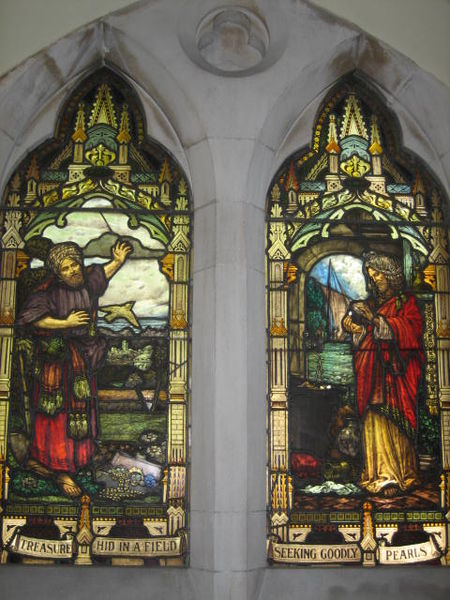
The picture shown here is a depiction of the Parable of the Pearl (right) paired with the Hidden Treasure (left) on a stained glass window in Scots' Church, Melbourne.

I've always loved the hymn, It Is Well With My Soul. In case you don't know this hymn, here are the lyrics:

It Is Well With My Soul

When peace like a river, attendeth my way, When sorrows like sea billows roll; Whatever my lot, Thou hast taught me to say, It is well, it is well, with my soul.

Refrain: It is well, with my soul, It is well, with my soul, It is well, it is well, with my soul.

Though Satan should buffet, though trials should come, Let this blest assurance control, That Christ has regarded my helpless estate, And hath shed His own blood for my soul.

My sin, oh, the bliss of this glorious thought! My sin, not in part but the whole, Is nailed to the cross, and I bear it no more, Praise the Lord, praise the Lord, O my soul!

For me, be it Christ, be it Christ hence to live: If Jordan above me shall roll, No pang shall be mine, for in death as in life, Thou wilt whisper Thy peace to my soul.

But Lord, 'tis for Thee, for Thy coming we wait, The sky, not the grave, is our goal; Oh, trump of the angel! Oh, voice of the Lord! Blessed hope, blessed rest of my soul.

And Lord, haste the day when my faith shall be sight, The clouds be rolled back as a scroll; The trump shall resound, and the Lord shall descend, Even so, it is well with my soul.

The story behind this hymn is pretty interesting. The lyrics were written by Horatio Spafford in 1873. Spafford was a lawyer from Chicago who suffered a series of calamities, including the loss of his four daughters when the ship they were on went down at sea. His wife was also aboard the ship (the Ville de Havre) but she survived - miraculously - as a plank floated under her unconscious body and kept her afloat until she was rescued.

Upon receiving word of the terrible tragedy (which claimed the lives of a total of 226 people) Spafford boarded the next ship in order to join his distraught wife. The captain of the ship called Spafford to the bridge as they were passing the site at which his daughters had died and then Spafford returned to his cabin and wrote this hymn. I should mention that this was simply the precipitating loss from which the hymn was written - but there were tragic events both before and after this one which give some indication of the depth of Spafford's faith.

All that to say, this has always been for me a powerful hynn. And I've loved to sing it, always feeling that it is a testimony of my faith, regardless of the immediate circumstances of my life. It is well with my soul... There's something profound in this statement. I like this hymn so much that my husband knows that I want it to be sung at my funeral.

Lately I've been thinking that it's a very good funeral hymn, but maybe it's use between now and then may not be such a good thing. Let me explain.

It seems to me that we - and by "we" I really mean "I" but with the suspicion that what is true of me is also true for many others who have been raised in the cultural context of this era and place - have tended to put perhaps too much emphasis on our "personal relationship" with God. This seems perfectly natural - after all, we are each one made in the image of God and each one of us is of inestimable value to God. The health and vibrancy of our relationship with God is quite naturally something to pay attention to. But I'm wondering how much our cultural promotion of individualism might also be at play.

I think that one of our blindspots in Christian thought and practice in North America is our over-emphasis on the individual at the expense of community. If we think for a minute that there might be a "soul" that is not confined to the individual - a social soul or a church soul or a kingdom soul - then there is a disturbing paradox for me. How can it be well with our collective soul when there are so many injustices in our world? And, to take it a step further, maybe our failure to think or feel or act out of our collective soul is a fundamental reason that the church as we know it is not more actively engaged in promoting justice as an expression of our love for our neighbours.

Perhaps the wellness of our collective soul has lulled us into a sense of complacency - a sense that life is hard and that unanticipated perils await us on our journey through this life, but God is good and faithful and he will neither leave us nor forsake us. All of this I think is perfectly true, but in the absence of attention to our collective soul it is easy to think that there is nothing that we need to DO. And yet, as I read the Scriptures, I struggle with this presupposition. I see in the Gospels and in the writings of Paul and other New Testament authors all kinds of direction for putting our faith in a sovereign and good God to good practical use.

Jesus weeps over Jerusalem (see Luke 19:28-42). In the Sermon on the Mount (Matthew 5-7), Jesus says that those who mourn will be comforted. We often hear this quoted at funerals, but what if Jesus was not talking so much about personal loss and grief, but the grieving of our collective Christian soul over the multitudinous abuses - abuses against the poor and marginalized, against creation, against God, against our own humanity...?

There is a sense in which I long to feel that even in the midst of these kinds of abuse, I can sing to God, proclaiming that I know him well enough to be able to say, it is well with my soul. But I also want to be part of a movement of people who know that God is grieved by the state of our world, and to know him is to share in that grief. Yes - Jesus has shed his own blood for my soul and that gives me great comfort and hope - and one day the trump shall resound and the Lord shall descend. BUT we're in this together.

Let's not kid ourselves. God IS grieved by the socially manufactured poverty and the socially acceptable forms of greed and exploitation that are often the basis for worldly "success". Most of us haven't faced the kinds of consecutive tragedies that Horatio Spafford endured leading up to and following the writing of It Is Well With My Soul and perhaps we are a little too quick to claim this hymn as our own testimony when we are actually guilty of twisting and distorting and diminishing the lesson of the pearl of great price (see Matthew 13:45-46).

I started this post with the assumption that it was the loss of his four daughters that really inspired Spafford to write this hymn, but maybe this really was just one of a series of events that so demanded his attention that he could finally see through the circumstances of tragedy to behold that pearl of great price. As usual, more questions than answers...!

The big question for me is whether we are in error - and if that error is a small error or a very large error - when we default to thinking of the state of the soulas a fundamentally individual matter as contrasted with a more collective sense of soul - the soul of the body of believers (i.e. the church universal). And, almost as an after thought in this post, now I'm wondering anew about the pearl of great price. What is it exactly and how is it attained? Or is it?

Wednesday, August 25, 2010

Involuntary simplicity...?

Over the last few years I've been conscious of trying to live more simply. But I have to admit that it's not easy and most of the time I fall short of the mark. And it's a pretty elusive mark. How am I to define living simply in this place of such extravagance and abundance and waste? I have absolutely everything that I NEED and pretty much everything that I WANT. I can honestly say that there is really NOTHING - no consumer product - that I need. As I think ahead even, I'm certain that I could get buy quite nicely - probably for years - without buying ANYTHING except food (well, maybe a few more things like gas and insurance and other "staples"). But I also know that I WILL continue to buy - to keep up to date with the latest electronics, fashions, trends, and my own whims.

So I'm thinking about the concept of voluntary simplicity - the self-imposed commitment to consume less. We may think of this as a modern movement but it actually has roots that can be traced back centuries. Many religious traditions have encouraged simplicity for spiritual, social and ecological reasons. The current voluntary simplicity movement is nothing new and for most of us is likely a quite watered down version of ancient practices. So what is the REAL value of voluntary simplicity? Does it help one connect more closely to God? Does it really reduce our ecological footprint in any significant way? Does it contribute to a more just society? Bottom line, what difference does it make if I discipline myself to leave the things that I don't need on the shelf - or increasingly - out of my various online shopping carts? These are not idle questions. I think about them a lot - almost to the point of obsession!

Here's the line of my thinking:

1. consumerism is a serious addiction and most of us (in the western world) have it to some degree. All addictions affect the person who is addicted - obviously - but also people around them, maybe even to the ends of the earth.

2. this addiction DOES have spiritual, ecological and social consequences. On the spiritual level, any addiction is idolatry - it obscures our view of God and hinders our ability to relate to God. We're much more like the rich young ruler than we like to think. If you don't know about the rich young ruler, check out these passages which all give an account of the encounter between the rich young ruler and Jesus: Matthew 19:16-30, Mark 10:17-31, Luke 18:18-30. From an ecological point of view I think there is no doubt that our addiction to stuff is hazardous to the planet. The earth's resources, as profound as they are, are not limitless and they cannot sustain us - and by us, I do mean all 7 billion of us on the planet - if we continue to plunder and waste them. There really is only ONE earth and - as I've mentioned in frequent previous posts - our current lifestyle is truly unsustainable from a purely ecological perspective. And finally, in terms of social impact and social justice, we in the western world - the one billion of us who control and consume 86% of the earth's resources - are guilty of oppression and exploitation, whether we intend it or not.

So, what to do? Voluntary simplicity is a great place to start, but is it enough? What if one person in one thousand voluntarily reduces our level of consumption? The benefit may be mostly to us - we are freed from the compulsion to buy, to consume, to own, to plunder. We are free to live more authentically - spiritually, ecologically and socially. We find that we have a better quality of life - it's less cluttered by the desires and obsessions that are inherent in any addiction. But at that level - 1/1000 - the ecological and social justice impact may not even be noticeable. I wonder what it would take to get the commitment to voluntary simplicity to a level that IS noticeable - 1 in 100, or 1 in 10 or 1 in 5? What would it take to get to a level of simplicity that humanity is actually able to address the systemic roots of injustice and oppression? And will we ever get there through voluntary commitments?

Moving from voluntary to involuntary simplicity may not be as extreme as it sounds. For instance, there have been times in the not so distant past when gasoline or food was rationed. Compliance was mandated by law and offenders were prosecuted. Nothing voluntary about that. Nobody likes to have their choices restricted, but sometimes it's necessary in order to address the social consequences of our natural bent towards greed and selfishness.

I'll continue to strive for simplicity but honestly, it will be easier for me to comply when public policy forces me to live more simply. So maybe some of my effort should go into supporting public policy that will do just this. In fact, I'd say that we'll know that we're really serious about the simplicity thing when political parties who promise to enforce simplicity measures actually get our votes. This is not a political plug and I'm not an extremist. I know I'm not an extremist because if I were, I'd be much better at leading by example. No, I'm just thinking this through and wrestling with the big picture stuff.

Voluntary compliance is always more appealing than involuntary - or mandated - compliance - but the fact is, the majority world cannot afford to wait for us to coax everyone on board. While we're patting ourselves on the back for taking a few steps towards a simpler life, they are living with the chronic indignities that come with lack of food, water, shelter, sanitation, education and medical care and they are too often dying for lack of these basic necessities.

We can and should and must, continue our individual efforts but we should also support public policy that will force us to live more responsibly and generously. And for those of us who claim to be followers of Christ, this is as much a part of our spiritual discipline and discipleship as prayer and fasting and worship and bible study and compassion.

Wednesday, July 07, 2010

The Advocacy Stand-Off

I have to say that I increasingly find my views and convictions around advocacy out of step with emails that find their way into my inbox. I suspect that we are on the verge of a major stand off in Canada between our federal government and all kinds of advocacy groups. CIDA's de-funding of Kairos late last fall (see http://www.cjpme.org/DisplayDocument.aspx?DO=795&RecID=416&DocumentID=675&SaveMode=0 for Kairos' fact sheet on this issue) and the more recent indications that the Canadian Council for International Cooperation (CCIC) will also have their funding slashed - are two important water marks that quantify the chill that is growing between our federal government and prominent advocacy groups.

These groups clearly see it as an important part of their mandate to relentlessly criticize government policy and policy makers for failing to solve the serious global problems which immiserate a billion or more people on this earth. To be clear, I suspect that for many of these agencies the problem begins when the federal government fails to live up to the commitments and promises it makes. The frustration over this - especially as both the leaders and the grass roots members of these organizations literally rub shoulders with the global poor and marginalized whose lives WOULD be made less miserable if governments of the G8 countries would just keep their promises - boils over into a pervasive and seething anger which subsequently influences every advocacy initiative.

It IS frustrating when the failure of so called "wealthy" nations to keep their promises means that the poorest of the world's poor continue to live in abject poverty and without dignity. But let's be realistic. The problems are incredibly complex. Money, though a necessary part of the solution, is only one part, and I would argue, not even the most important part. And when faith-based and other civil society advocacy groups focus on the dollars, we perpetuate the lie that more money can solve the problems. Governments provide a convenient scapegoat but we have to remember that governments are NOT gods. They are not omnipowerful or, omnicompetent (as Bruce Clemenger of the Evangelical Fellowship of Canada likes to say).

Governments do what they have to do to maintain their positions of power. They are often hanging onto power by a thin thread. They cannot and will not be able to lead effectively on the global stage if they are vulnerable to a fickle and selfish constituencies at home. The righteous indignation of Canadian advocacy groups - like Kairos, the Canadian Council for International Cooperation, the Council of Canadians, the Canadian chapter of Make Poverty History (to name a few) is but one voice that the government hears. And who do these organizations speak for? How representative are their views? Do they have the support of the business sector? Let's face it, if we seriously expect our governments to put their commitments to the Millennium Development Goals ahead of the pressures for economic growth from the business sectors of their own economies, I think we need to change our tactics - and possibly our hearts.

I cringe when I hear the language of rights and of demands and of anger defining our advocacy and our public voice and presence. I think we mean well. I KNOW we do. I understand - and share - the frustration with policies and policy makers and the feelings of helplessness in the face of such horrendous suffering. But let's not spend so much of our time and resources chasing after vague promises of more money - except when it is programming money that we KNOW is being well spent and making a positive difference for our partners. Let's divert THAT advocacy time and those resources to efforts to change our own cultures and our own constituencies.

When widespread public opinion in our privileged countries champions the causes for which we advocates and social activists are passionate our governments will have the moral authority and political capital to keep their promises - and not just promises to provide money but more importantly to design and implement structural reforms. There are lots of addictions in our societies that will need to be confronted if we are to win over public opinion. We have our work cut out for us!

Friday, July 02, 2010

From Starfish to Whales: When Rescue Efforts are Viewed with Suspicion

In the last post I talked about the little boy who rescued the starfish which had been stranded by the tide. Yesterday I participated in a whale rescue – or I should say, attempted whale rescue. REALLY – I did! My husband and son are commercial fishermen. Amongst other things, they catch juvenile herring in weirs – you would probably recognize them as sardines (an excellent source of calcium and omega 3, by the way!).

Weirs are large stationary traps – they cover about an acre of ocean floor – and they catch herring by being strategically placed in the “fishways” of the herring. That is, over the years, fishermen study the local habits of the herring and then build weirs which are literally “in their way”. According to the tide and the dark and daylight hours, the fish swim in schools into the weir where they find themselves trapped. For the most part the heart shape of the weir keeps them from finding their way out as they circle around and around.

Of course fishermen often catch things in their weirs besides herring – mackerel, dogfish, squid, the occasional blue fin tuna or shark. Seals appreciate the weirs because they provide them with captive meals and snacks virtually 24 hours a day. Rarely, but on occasion, a whale will also find itself inside a weir. They swim in, often oblivious to their surroundings, as they feed on herring or on krill – the small particles for which our area is noted and which make it a productive fishing area.

Years ago fishermen saw a whale in the weir as a minor nuisance and if it didn’t swim out on its own, it was likely to be shot or harpooned and unceremoniously towed out to deep water or to a beach somewhere. That was before whales became endangered and before our fascination with them spawned a cottage industry in whale watching. It was also back in the day before the environmental movement and the emphasis on recycling - back in the day when fishermen threw their pop cans and trash into the ocean. Now, most fishermen most of the time are much more environmentally responsible.

So, a few days ago my husband returned from tending the weir – that is, checking it for herring - with the news that there was a minke whale trapped in the main weir. Minkes are small whales, usually 18-25 feet long when they're mature. The main weir is the part the fish swim into initially. If conditions on the ocean floor permit, the weir will also have a “pound” or holding area. Fish that are caught in the main weir will be “seined” into the pound where they can be held until there’s market – that is, until the one sardine processing company (Connors Bros.) can send a carrier (large boat with a hold for transporting fish to the plant). I realize as I write this that for many of you, this is a whole new language!!

I love watching whales so naturally I was delighted to hear that I would have a chance to visit one at my leisure. My husband was less pleased, having just finished the spring lobster season – two months of 80-90 hour weeks. Nonetheless, yesterday – while others were participating in Canada Day celebrations - we set out around 10am to “free” the whale. My husband and son were in one skiff and my 80 year old mother-in-law and I were in another.

It was a stunning summer day - the kind that makes me wonder why anyone would want to live anywhere else. The weir is only a few minutes from the wharf – it’s REALLY beautiful here by the way! Any hope that the whale might have rescued itself was abandoned as soon as we got to the weir and saw it surfacing.

The rescue plan was for us to encourage the whale to swim out of the mouth of the weir by using a combination of noise – the two outboard motors – and a seine – a net used for getting herring out of the weir when there’s market. The challenge is to be firm but not intrusive. The last thing you want is a panicked whale swimming in a tight space. I won’t go into the blow by blow details. I’ll just summarize by saying that we got the whale out of the main weir – after a tense moment when we were convinced that it had actually drowned on bottom, caught between two stakes. But I neglected to mention that part of the weir construction is what’s called the “wing” and the “wing” is designed to corral the herring into the main weir. Part of the wing is called the “hook” and unfortunately, in this case, the deepest water is in the hook. Naturally that’s where the whale wanted to be.

The next challenge was to get the whale out of the hook, down the wing and to freedom, NOT back into the weir. After several failed attempts at this – we’d get him (or her - I have no idea) out of the hook and once he even got clear of the wing but in order to get to open water he had to swim over a shallow place – a “ledge” – and despite our earnest reasoning, he simply didn’t trust us and was frustratingly persistent in his efforts to return to the hook.

After several hours all told, my husband decided to wait until the tide conditions would help us to help him by giving him more water in which to swim over the ledge. Another important detail is that where we live there's about 28 feet rise and fall of tide which means every 6 and 1/2 hours the tide rises or falls 28 feet (which is very impressive!).

The happy ending to the story is that when my husband went back about 4 hours later, he was able – singlehandedly (well that is, with his skiff) to gently push the whale over the ledge by circling behind him. So all in all, it’s fair to say that I participated in phase one of the rescue.

All that to say that I couldn’t help thinking of some similarities and differences between rescuing stranded starfish, this minke whale and humanitarian aid and development in developing countries.

I guess technically the whale didn’t NEED our help. He was just in the wrong place – from the fishermen’s perspective - since a herring weir isn’t going to catch herring when there’s a whale in it. But the fact is, we wanted to help it get out of the trap it was in to open water. We wanted to do it good. To set it free. It, however, had other ideas.

It didn’t trust us, didn’t particularly like us and it wasn’t impressed with our efforts or our intentions. I’m not sure exactly where I’m going with this… but the thing is, it resorted to its instincts for survival. Those instincts might have worked in some circumstances – or even in this circumstance, given enough time. And in a state of nature, there wouldn’t BE a weir in his way. Similarly, if we substitute local knowledge and cultural heritage rather than instinct, people in African countries, for example, have been perfectly capable of solving their own problems – at least when they are in situations of their own making or even when faced with natural events.

But human intervention or “progress” being as it is, we could say that global realities – economic and political and even environmental – have put obstacles in their way. Trade policies, reckless environmental impacts of decisions made by large corporations who don’t answer to African governments (or maybe even to their own national governments!), economic and political strings...all conspire quietly to frustrate their efforts at sustainability. Then humanitarian aid and development workers come into their country and want to help them escape from their poverty traps. Is it any wonder that they might be a bit suspicious?

Is it too much to suggest that perhaps their scepticism is warranted and that resisting our “help” may actually be a prudent course of action?

I’m also conscious – and uncomfortable – as I write this that I am portraying people in developing countries as somehow less advanced than we are. I realize that for the sake of the analogy I am casting US in the role of benevolent fisherman (or little boy in the case of the starfish) and THEM as helpless starfish or confused whale. This is, I’m sure, an unfortunate but almost inevitable bias – part of our ethnocentrism.

I don't want to make too much of this, but again, I'm just thinking through what it means to be engaged in aid and development. I'm not suggesting that we stop trying to do good - only that we do it with great care and compassion and a realization that we CAN do harm, even when we don't intend to. Hey - if it's THIS complicated for me to explain the relatively simple procedure for getting a whale out of a weir, think how much more complicated is the life of peoples in countries and cultures half a world away... or across the street in some cases.